The Problem With "Just Check the Dashboard"
Many strategy calls start the same way. Someone asks a simple question: "Where is our traffic coming from, and is it working?"
The answer lives in six different places: GA4 for behavior, Search Console for organic visibility, Google Ads for paid search, Meta for social campaigns, Google Business Profile for local signals, YouTube for video reach, and so on.
Each platform speaks its own language, measures different things, and disagrees with the others about attribution.
The standard approach is to open each one, export or screenshot, paste into a deck, import a data source and present a version of the truth that took four hours to assemble.
This is not an analytics problem. It is an architecture problem. The data exists. The connections between sources exist. What doesn't exist, until now, is a single place where you can ask a question across all of them at once.
The Idea
The concept behind Stack Chat is simple: connect every marketing data source to a single AI-powered conversation layer. Ask a question in plain English. Get an answer that draws from all connected sources simultaneously.
The technical term for this kind of integration is MCP, Model Context Protocol. It is an an open-source protocol that allows AI assistants to connect directly to live data sources.
Stack Chat is built on this standard, and it is an early client-facing implementation designed specifically for digital marketing intelligence.
The insight was not that AI could analyze marketing data. That has been possible for years. The insight was that fragmentation, not analysis, is where time, transparency and energy get lost. Hopefully, this MCP can help solve that.
What It Took to Build
The road from concept to working tool was not clean. Each data source has its own authentication model, its own API structure, its own rate limits, and its own clunkiness.
Google's OAuth flow is different from Meta's. The YouTube Analytics API requires channel-owner authentication and does not support the same property-level user settings as GA4. For Google Business, a separate API access request is required. Meta's Business Manager flagged a newly created account as suspicious automation within hours of setup.
None of these are unsolvable problems. But each one required a specific decision: how to handle token storage, how to manage multi-source errors gracefully, how to surface meaningful errors to the user without exposing raw API responses in the interface.
The architecture that came out treats each source as a self-contained module.
- GA4 has its own fetch functions, its own insight cards, its own status indicator.
- Meta Ads connects through a locally hosted MCP server running as a system service.
- Google Business Profile authenticates through the existing Google OAuth token with an additional scope.
Each source can fail independently without taking down the others.
The most important architectural decision was to never let a broken source block the conversation. If Google Ads returns a permissions error, the other five sources still load. The user still gets answers. The system degrades gracefully.
What Clients Experience
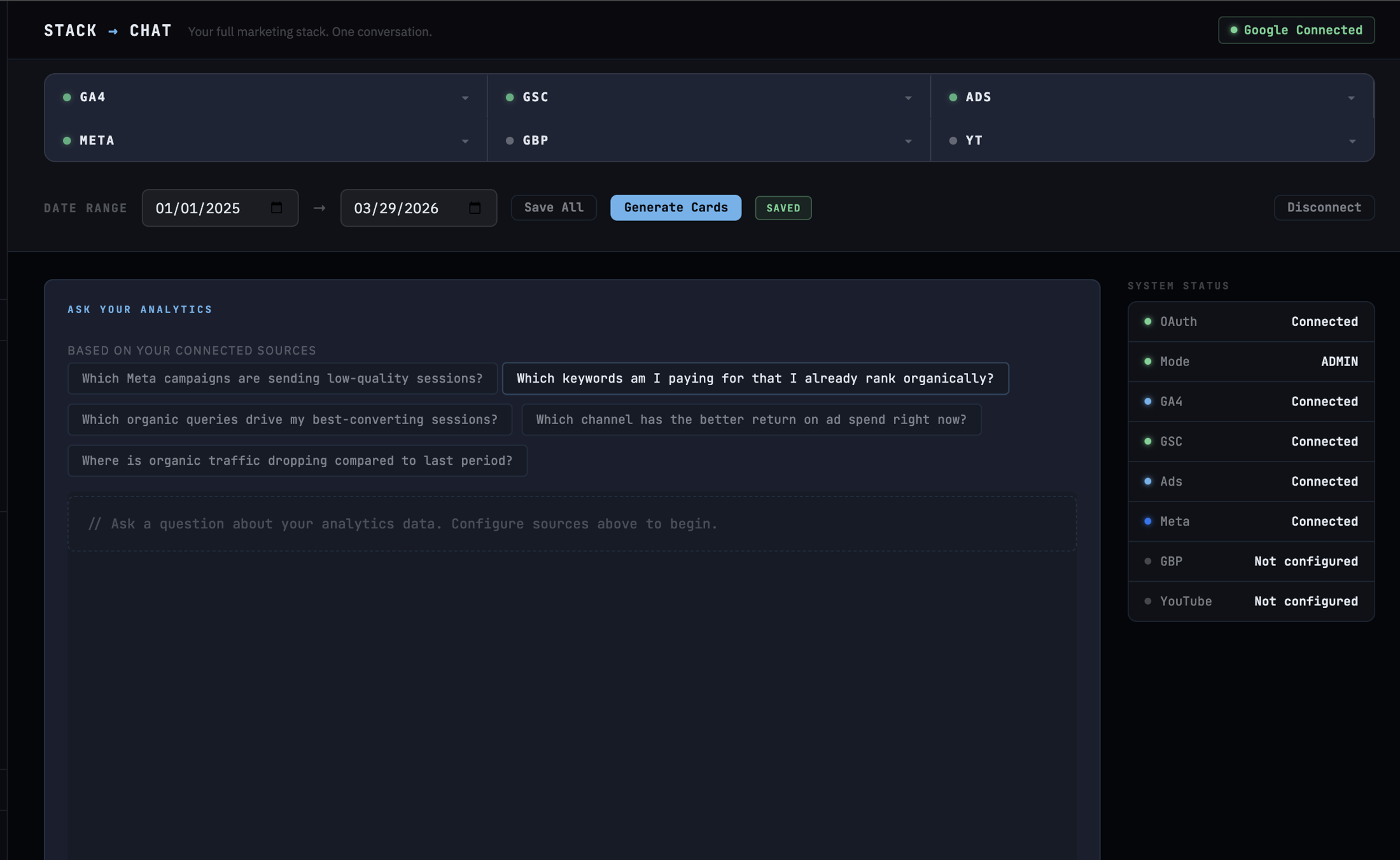
The typical Stack Chat session starts before the meeting. The client has already granted read-only access to their accounts:
- GA4 (viewer)
- Search Console (full access)
- Google Ads (read only)
- Meta account (partner access)
The intake form walks them through each platform with numbered instructions and direct links. Setup takes about fifteen minutes on their end.
When the session begins, all sources are visible in the interface as a status bar. Green means connected and pulling data. Amber means there is an issue worth investigating. The structured insight cards load automatically, one per data source, showing the key metrics for the selected date range.
Then the questions start.
"Which of my Meta campaigns are driving sessions that actually convert, versus ones that inflate traffic numbers?" That question crosses GA4 and Meta. The system reads both, finds the overlap, and answers with the actual data from both sources in context.
"Are we paying for Google Ads clicks on queries where we already rank first organically?" That question crosses Google Ads and Search Console. The answer used to require a manual VLOOKUP. Now it takes ten seconds.
"My GBP calls dropped 18% this month but my website traffic is up. What's happening?" That question crosses GA4 and Google Business Profile. It is the kind of cross-source insight that rarely gets asked because the data has never been in the same room before.
The preset question chips in the interface update automatically based on which sources are connected. If the client has Meta and GA4 but not YouTube, the system surfaces questions relevant to that specific combination. The intelligence is in the prompts, not just the data.
What This Means for Strategy Calls
The shift is from reporting to thinking. When a meeting no longer needs to spend thirty minutes establishing what happened, it can spend that time on what to do about it.
I have watched client meetings change in structure when the data is already present and queryable.
The conversation moves faster. Hypotheses get tested in real time. "What if we shifted 20% of the Meta budget to Google Ads?" is a question that, with all sources loaded, can be explored with actual numbers from both platforms in the same conversation.
The voice input feature means the client can ask questions out loud during the meeting. No typing required. The waveform animation confirms the system is listening. The response appears in seconds.
What Comes Next
Stack Chat currently supports six sources. LinkedIn Ads, Google Merchant Center, and TikTok Ads are next, if I don't break everything by then. The modular architecture means each new source is a contained build, not a rewrite.
The tool exists. The infrastructure is running. The data is live.
What changes now is how strategy conversations happen. Insight extraction used to be preparation work done before the meeting. With Stack Chat, it happens inside the meeting, in response to the specific questions that matter to that client, on that day.
That is what the tool was built to do.
Stack Chat is available to k0k1man.com clients as part of the strategy session workflow. Access requires granting read-only permissions to connected platforms. All data is read-only and access can be revoked at any time.